(4) Structure of the tower TOKYO SKYTREE Structure
02
The tower is constructed from approximately 37,000 pieces of Steel framework.
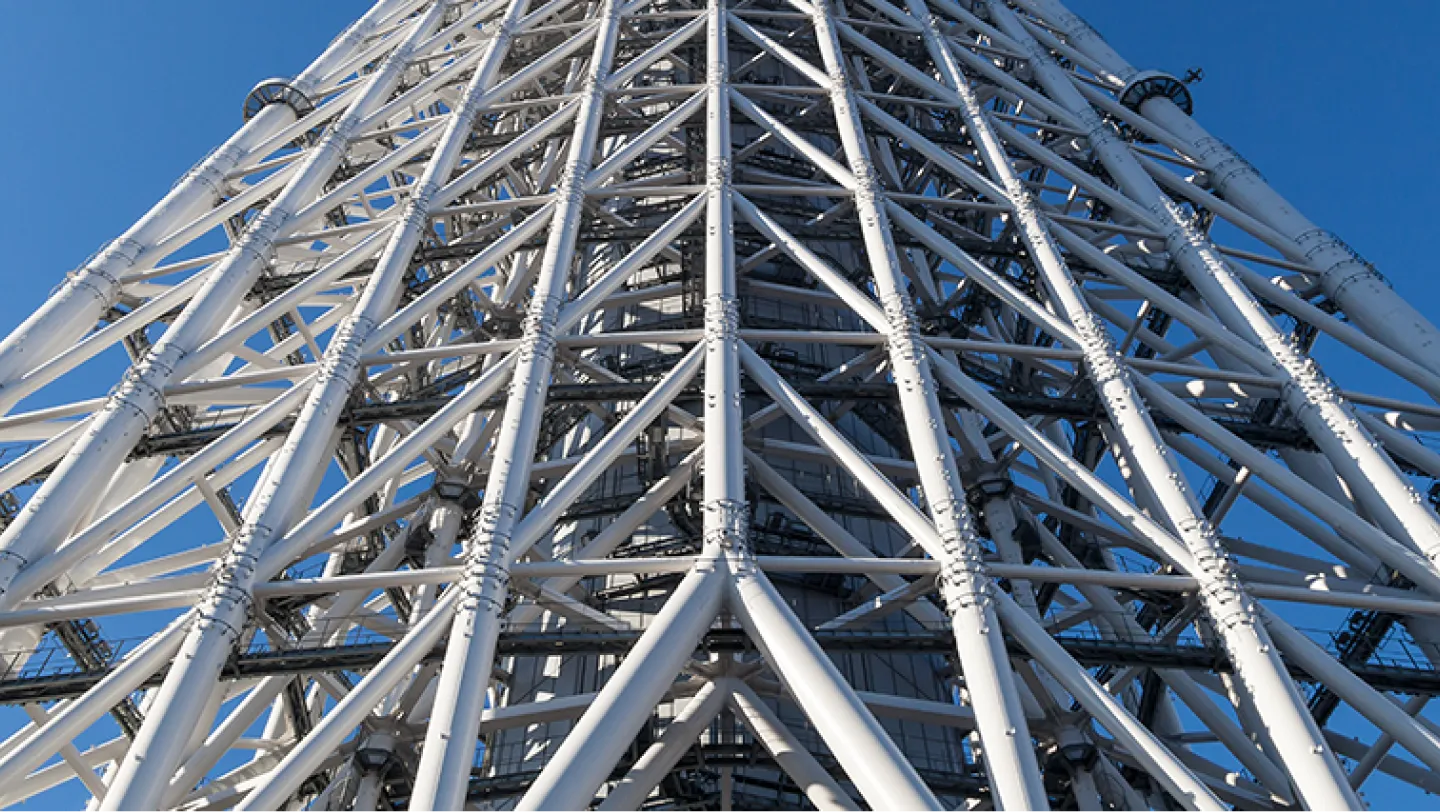
It was constructed by welding together approximately 37,000 Steel framework using a " Truss structure " in which steel pipes are combined in a triangular shape.
Sturdy Steel framework
The TOKYO SKYTREE is constructed from a large number of Steel framework.
| Twice as strong Steel framework | To support the slender Tower, we used Steel framework made of steel that is about twice as strong as standard steel. |
|---|---|
| Various sizes available | The steel pipes that make up the Steel framework are also of various types. The largest steel pipes are 2.3 meters in diameter and 10 centimeters thick. |
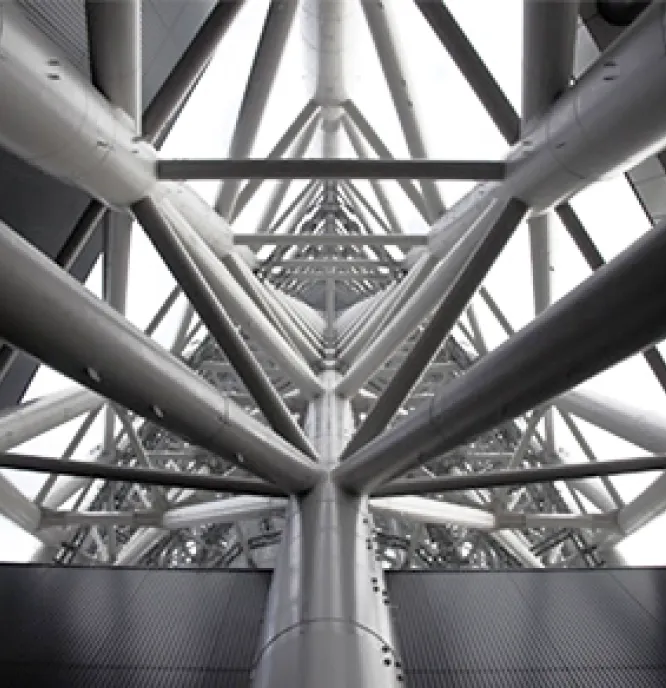
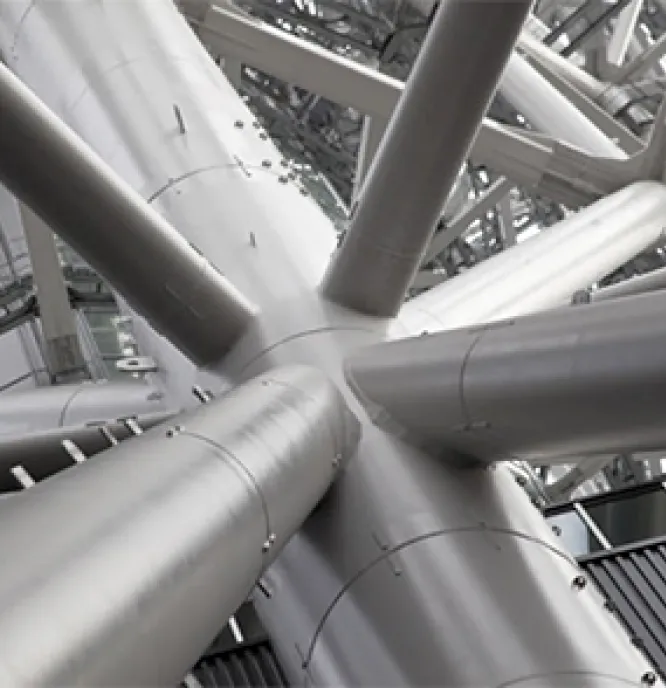
| They are made in pieces and assembled on-site. | The Steel framework utilizes a technique called "branch joints," where cylindrical steel pipes are directly joined by welding. These pipes were manufactured in 19 factories across Japan and then assembled by welding at the Tower construction site. |
| Approximately 37,000 pieces in total | The tower itself used a total of approximately 37,000 Steel framework frames. Amazingly, each frame was a different shape, tailored to the specific location where it was to be assembled. |
| Truss structure | The Steel framework is constructed using a "Truss structure," which combines basic steel pipes with other steel pipes in a triangular shape to strengthen the tower. |
Mechanism to reduce vibration
The TOKYO SKYTREE , which is susceptible to Strong winds and earthquakes, has various mechanisms in place to reduce swaying.
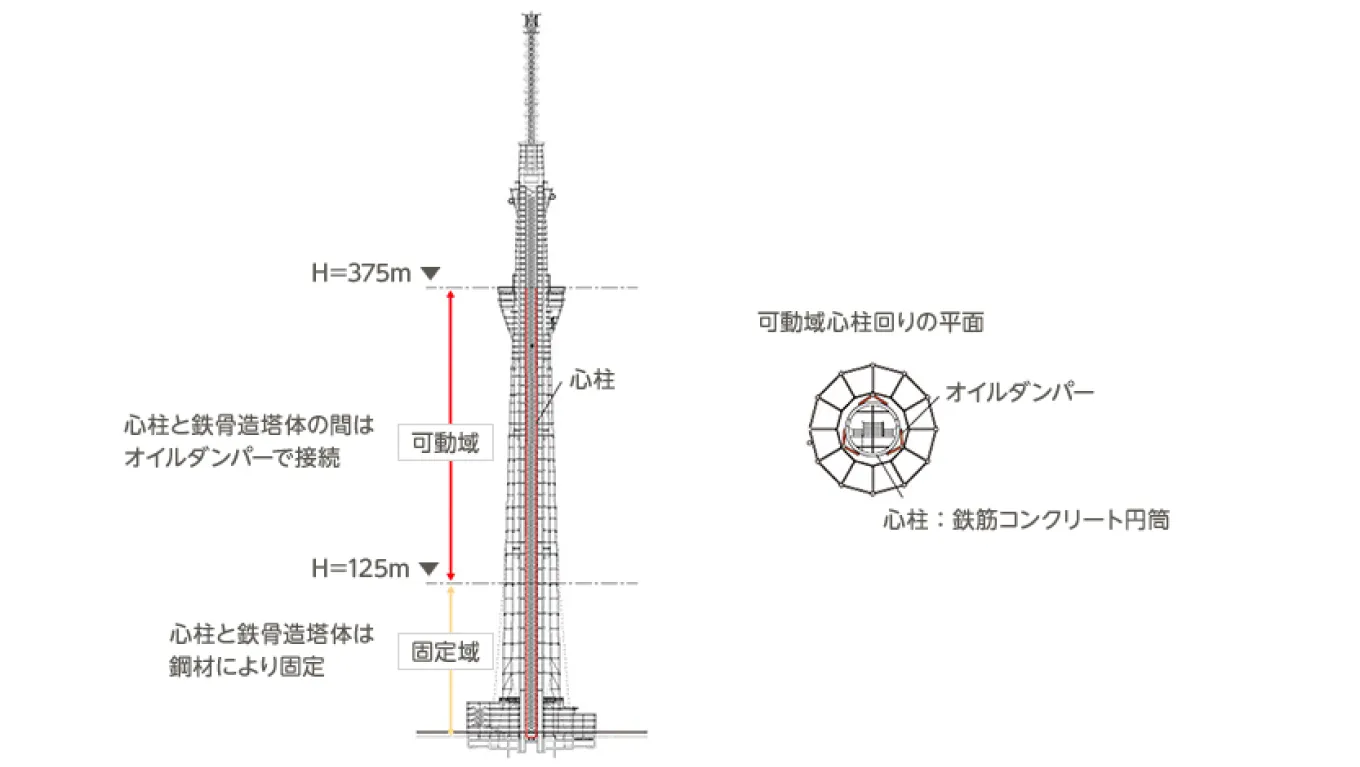
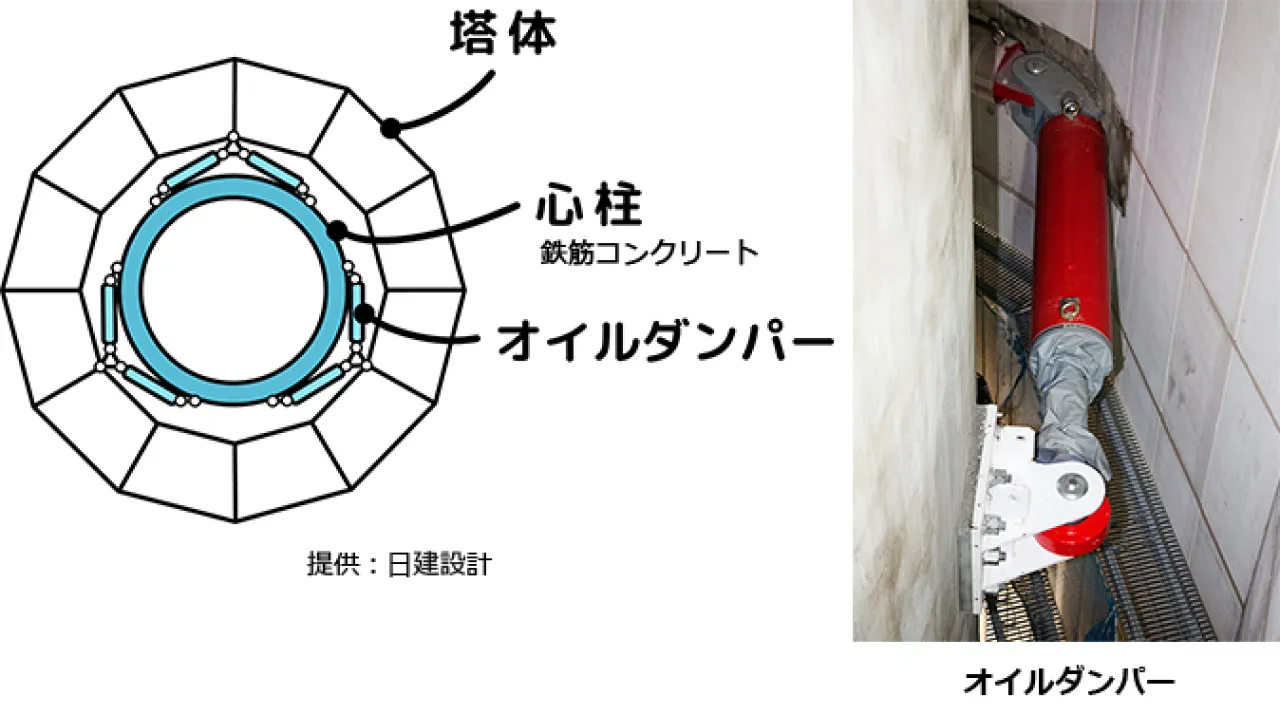
| 1. "Central pillar" Vibration Control System: "Central pillar Vibration Control" | During earthquakes or Strong winds, the Central pillar sways more slowly than the Steel framework of the tower. The difference in the swaying periods of the two cancels out the swaying, reducing the overall sway of the Tower. In addition, the oil dampers located between the tower and the Central pillar act as cushions, preventing the Central pillar from colliding with the tower. |
|---|---|
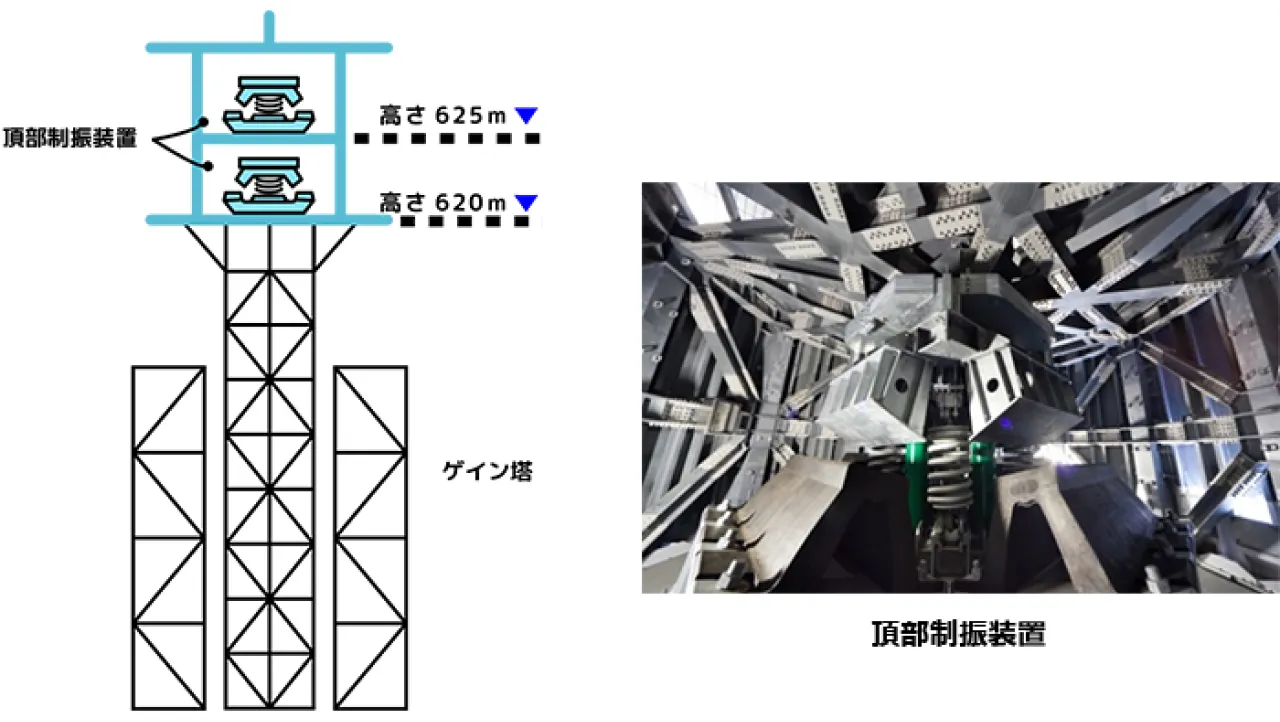
| 2. The vibration damping device acting as a counterweight: "Top vibration damping device" | The Antenna gain tower is the antenna mounting section at the very top of the Tower . At its tip, there is a vibration damping device called a "Tuned Mass Damper" that uses weights to reduce vibrations. |
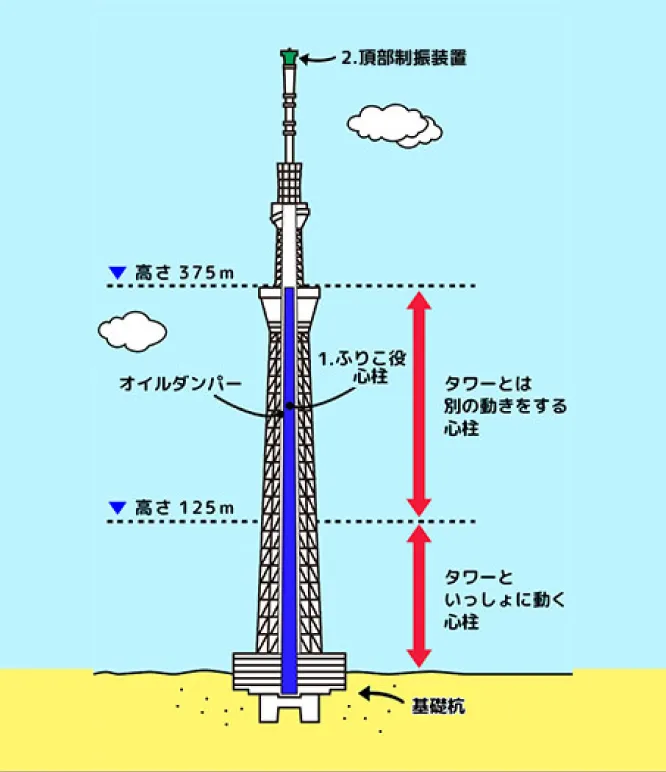
" Central pillar Vibration Control" - A vibration control system using a Central pillar - cancels out overall vibrations by using different vibration periods.
The TOKYO SKYTREE's tower body is Steel framework, while its Central pillar is made of reinforced concrete, each having its own unique period of sway. Because the Central pillar sways more slowly than the Tower body, the two types of sway cancel each other out, reducing swaying during Strong winds or earthquakes by up to 50%.
The Tradition Japanese Five-story pagoda pagoda has never collapsed in an earthquake, and one theory suggests that the Central pillar lies in the central pillar of the building. We named the vibration control system developed for the TOKYO SKYTREE "Shinbashira Seishin" ( Central pillar vibration control), drawing a parallel to the Five-story pagoda .
This reinforced concrete cylindrical Central pillar has a diameter of 8 meters and a height of 375 meters. Its thickness is 40 cm up to a height of 100 meters and 60 cm from a height of 100 to 375 meters.
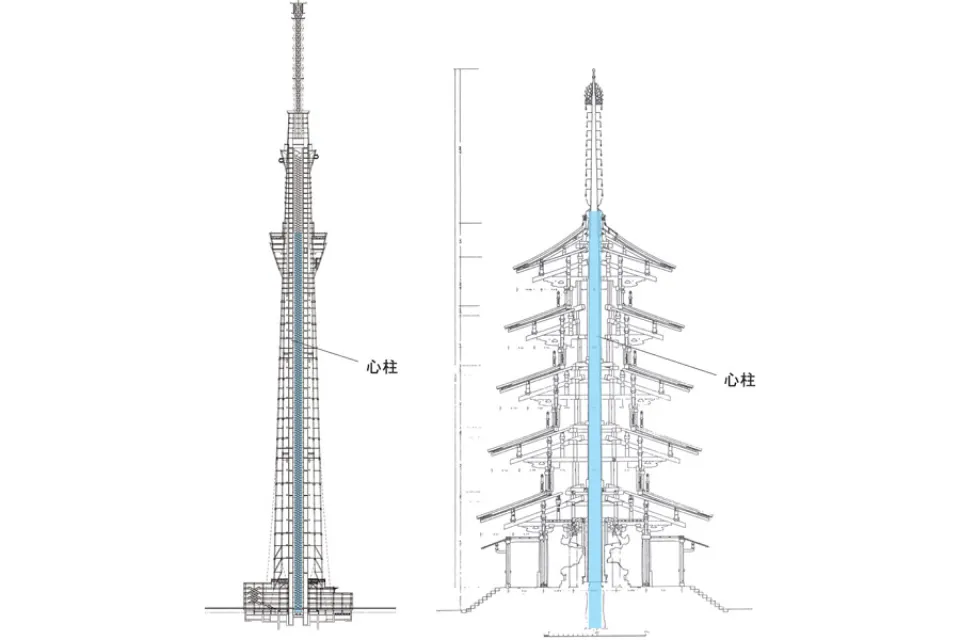
Provided by: Nikken Sekkei
Mass addition mechanism
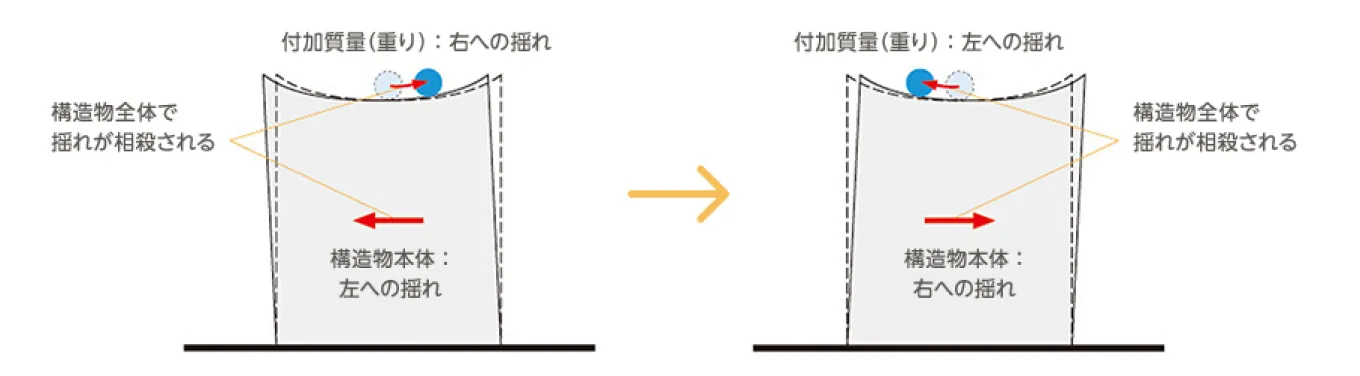
Central pillar concept (swaying) Model: Difference between models with and without a Central pillar
Provided by: Nikken Sekkei
Central pillar
Provided by: Nikken Sekkei
The top damping device, acting as a counterweight, reduces the vibration of the Antenna gain tower by up to 30%.
Oil damper - acts as a cushion
Related Videos
A thorough explanation! The secrets behind earthquake-resistant structures
Rare footage! The secrets at the top of TOKYO SKYTREE
Illuminating the night sky! The secrets behind TOKYO SKYTREE's lighting (Published September 29th: About the lighting)
- [ 1 ] The birth of TOKYO SKYTREE
-
- Construction of TOKYO SKYTREE
- "The city with a Tower"TOKYO SKYTREE TOWN
- The location where TOKYO SKYTREE stands
- The name of TOKYO SKYTREE
- For our international customers
- [ 2 ] A guide to the different parts of TOKYO SKYTREE
-
- Elevator at TOKYO SKYTREE
- TOKYO SKYTREE lighting
- Design of TOKYO SKYTREE
- [ 3 ] A structural introduction to TOKYO SKYTREE
-
- First, start with research into unknown areas
- A connection to the ground, like a large tree
- A clever design for connecting and integrating Steel framework.
- Overview of the Steel framework framed tower
- [ 4 ] The structure of the tower
-
- The tower is made up of approximately 37,000 pieces
- Mechanism to reduce vibration
- [ 1 ] The role of TOKYO SKYTREE
-
- Decision on a height of 634 meters
- Role as a Broadcasting Tower
- Role as an observation facility
- [ 2 ] Role during disasters
-
- It will continue to function as a radio tower even in the event of a major disaster
- The structure of TOKYO SKYTREE itself is resistant to disasters.
- Environmental Considerations